| At a Glance | |
| Common Name | String of Hearts, Rosary Vine, Chain of Hearts |
| Plant Type | Trailing succulent-like perennial |
| Light Required | Bright indirect light; some direct sun tolerated |
| Soil / Medium | Fast-draining cactus and succulent compost |
| Difficulty | Easy — more forgiving than String of Pearls |
| Mature Size | Trails to 90cm-2m in good conditions |
| Toxicity | Non-toxic to cats, dogs, and humans |
| Native Habitat | South Africa, Zimbabwe, Eswatini |
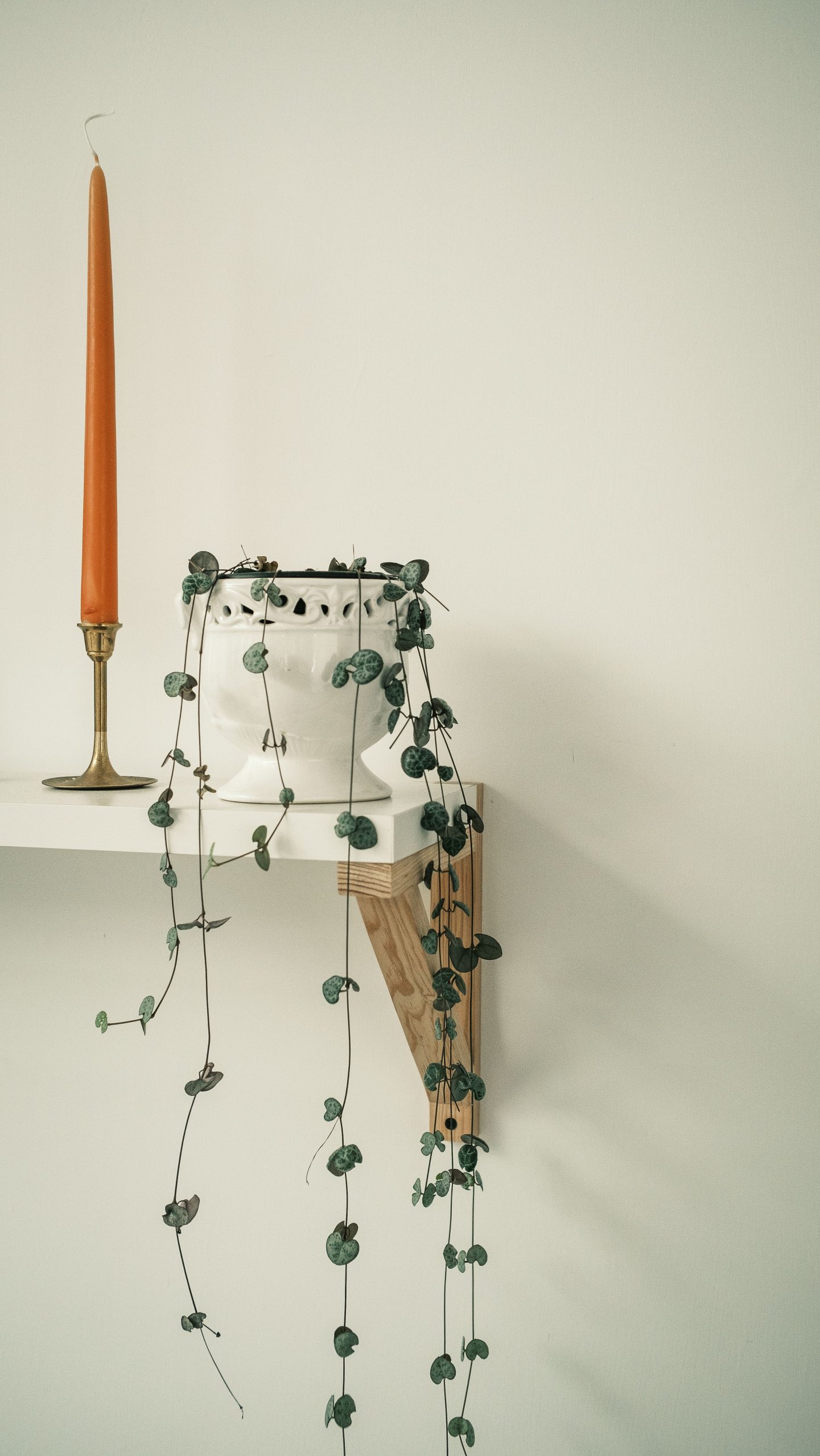
String of hearts has become one of the most sought-after trailing plants of the last few years, and its appeal is easy to see. The delicate chains of small, heart-shaped leaves in silver-green and purple — with their distinctive marbled patterning on top and deep purple undersides — have a refinement that larger-leaved trailing plants do not match. It is also considerably more forgiving than its close relative String of Pearls, tolerating underwatering, imperfect light, and the general inconsistency of real life better than most plants in this category. If String of Pearls has defeated you, String of Hearts is worth the attempt.
Light Requirements
String of hearts does best in bright indirect light with some direct sun tolerated — an east-facing windowsill with gentle morning sun is ideal. A south-facing windowsill with some direct sun in the morning or evening is also workable. The silver and purple colouring intensifies in brighter light; in low light the leaves become paler and more widely spaced on the vine.
More so than many succulents, string of hearts tolerates slightly lower light levels without the severe etiolation that affects string of pearls. The vines become longer and the leaves more spaced out in dim conditions, but the plant survives where string of pearls would decline quickly.
Soil & Growing Medium
Use a fast-draining cactus and succulent compost. The same rules apply as for string of pearls: standard houseplant compost holds too much moisture and increases root rot risk. A specialist cactus mix, or standard compost 50/50 with perlite, drains appropriately and dries out at the right rate.
Terracotta pots help by allowing moisture to evaporate through the pot walls as well as the surface, which suits this plant’s preference for drier conditions between waterings.
Watering
Water when the compost is completely dry — roughly every two to three weeks in summer, once a month or less in winter. String of hearts stores water in its small, semi-succulent leaves and tuberous roots. It is considerably more drought-tolerant than its delicate appearance suggests, and far more forgiving of underwatering than overwatering.
The leaves are a reliable indicator: firm, slightly convex leaves mean the plant is well-hydrated; flat or slightly wrinkled leaves mean it is ready for water. Mushy leaves or blackening at the base of the vines are signs of overwatering and root rot — act quickly if either appears.
Temperature & Humidity
String of hearts prefers 18-26°C. It is more cold-tolerant than many tropicals and can handle brief dips to around 8-10°C without damage, though growth stops. Keep away from frost — it is not hardy outdoors in the UK year-round.
Low to moderate humidity suits it well. Unlike calatheas and ferns, string of hearts does not need supplemental humidity and actually prefers drier air. Do not mist it. A dry, well-ventilated room is correct.
Fertilising
Feed two to three times during the growing season (April, June, August) with a cactus and succulent fertiliser at half strength. String of hearts is not a heavy feeder; over-fertilising produces weak, soft growth and reduces the compact, decorative quality of the vines. Skip feeding entirely in autumn and winter.
Grow Light Compatibility
String of hearts adapts to grow lights better than string of pearls — it does not require the same high intensity and maintains its form at lower light levels. A modest full-spectrum LED at 10-12 hours per day produces good results. The silver leaf patterning remains vivid under adequate artificial light, where it would fade in genuinely low natural light.
Toxicity
String of hearts is non-toxic to cats, dogs, and humans — one of its genuine advantages over string of pearls, which is toxic. The trailing habit means the vines can be accessible to pets and children, and the absence of toxicity removes one concern from the equation. It is a genuinely pet-safe trailing succulent.
Pruning
Trim individual vines back if they become too long or bare at the ends. Cut just above a node or leaf pair — the vine will branch from below the cut. If the plant becomes sparse overall, cut several vines back and use the trimmings as cuttings to replant into the same pot, producing a fuller display.
String of hearts can look thin in its first year — it fills in noticeably in the second and third years as the root system and tubers develop. Patience pays off with this plant.
Propagating
Three reliable methods: water cuttings, soil cuttings, and aerial tuber propagation. For water cuttings, take a vine section of 10-15cm with several leaf pairs, remove the lower leaves, and place in water. Roots appear within one to two weeks.
For aerial tuber propagation: press a tuber along the vine against moist cactus compost in a small pot. Pin it down with a piece of wire or a hairpin. Roots develop within two to three weeks; once established, sever the vine below the tuber.
Both methods are reliable. The aerial tuber method is particularly satisfying because you can propagate while the vine is still attached to the mother plant.
Indoor Setup Notes
String of hearts suits high shelves, hanging baskets, and any position where the fine, trailing vines can cascade downward. The delicate quality of the vines reads best at eye level or above — on a bookshelf or suspended from a ceiling hook.
In a UK home, an east-facing or south-facing windowsill is the natural position. The plant is compact enough at the crown for a small space, with the vines taking up only vertical space below the pot. It is one of the better choices for adding a trailing element in a room without sacrificing too much horizontal shelf space.
Potting & Repotting
String of hearts prefers a slightly snug pot and flowers (produces its tiny pink tubular blooms) more reliably when mildly root-bound. Repot every two to three years in spring, going up by one pot size only. Use fresh cactus compost at each repotting.
The plant develops a tuberous root system over time. Take care not to damage the tubers when repotting — they store water and nutrients and are important to the plant’s health and drought tolerance.
Common Pests & Problems
- Mushy, blackening vine bases: Root rot from overwatering. Remove affected vines and check the root tubers. Repot in dry cactus compost and withhold water for two weeks.
- Flat, wrinkled leaves throughout: Underwatering. Water thoroughly and the leaves plump up within a day.
- Pale, washed-out leaf colour: Insufficient light. Move to a brighter position.
- Sparse, widely-spaced leaves: Insufficient light or the plant is still young. Improve light first; the vines fill in with age.
- Mealybugs: White cottony deposits at the base of the vines. Treat with isopropyl alcohol and neem oil.
- Fungus gnats: Overwatering. Allow the compost to dry completely between waterings; treat with a neem oil soil drench.
FAQ
Is string of hearts easier than string of pearls?
Yes — significantly. String of hearts tolerates lower light and more irregular watering without the immediate collapse that string of pearls shows under similar conditions. It is the better starting point for anyone who finds delicate trailing succulents challenging.
What are the little round beads on the vines?
Aerial tubers — natural propagation structures produced along the vines. They are harmless and useful. Press one against moist compost in a small pot to root a new plant.
Why is my string of hearts not growing?
In winter, minimal or no growth is normal. In the growing season, check light levels and whether the plant needs repotting. String of hearts establishes slowly in its first year — growth accelerates noticeably in year two.
Does string of hearts flower?
Yes — the small, tubular pink-purple flowers appear along the vines in summer, particularly in root-bound plants in good light. They are small and easily overlooked but distinctive.
Is string of hearts safe for cats?
Yes. String of hearts is non-toxic to cats and dogs, which makes it one of the better trailing plant options for pet-friendly homes.